




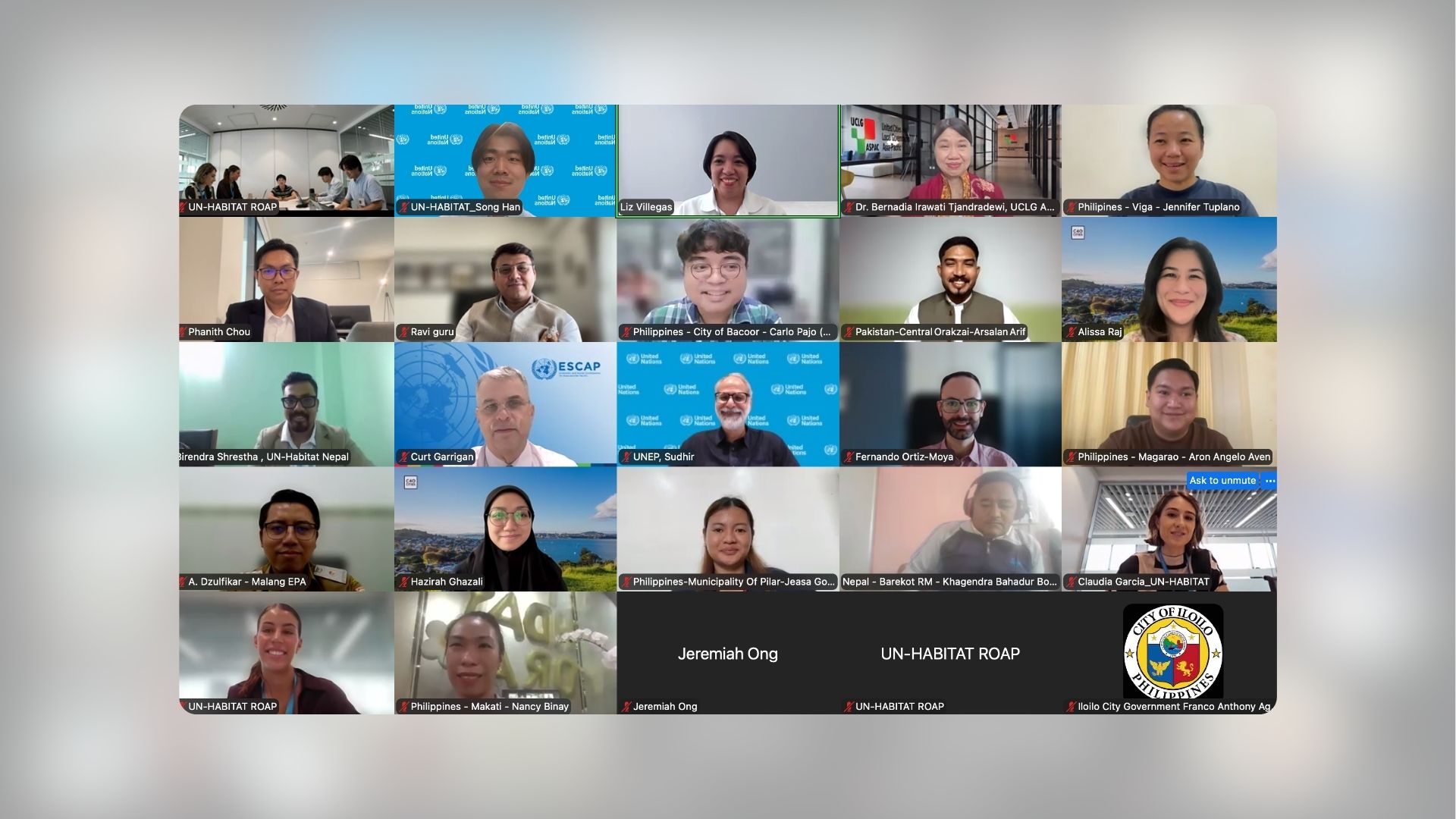
April 28, 2026 | UCLG ASPAC facilitated the Asia-Pacific Mayors Academy, now in its 7th year, which formally opened with a virtual session on April 28, 2026. This year, the academy gathered a total of 14 Mayors from 6 countries in the region: Chandigarh (India), Kendari (Indonesia), Barekot Rural Municipality (Nepal), Tribal District Orakzai (Pakistan), Bacoor City, Iloilo City, La Paz Municipality, Lapu-Lapu City, Makati City, Pilar Municipality, Viga Municipality, Vigan City (the Philippines), and Puttalam Municipal Council (Sri Lanka).
UCLG ASPAC led the module on Navigating a Multi-Crisis Context on May 12, 2026, which highlighted how integrated solutions can strengthen local responses to the triple planetary crisis and future shocks. In her welcome message, the Secretary General of UCLG ASPAC encouraged the Mayors to transform commitments into actions and to take steps in creating sustainable cities.
In the session on Managing Crises in Cities, Dr. Phanith Chou, Associate Professor of the Royal University of Phnom Penh, underscored the need to learn from nature and design solutions aligned with nature. Ms. Alissa Raj, Deputy Regional Director for East, Southeast Asia, and Oceania of C40, showcased how local leaders are delivering climate action inclusively and equitably. Mr. Sudhir Sharma, Regional Coordinator of the UN Environment Programme, explained how circularity can help manage and significantly reduce waste generated, particularly organic, plastic, and electronic waste. Mr. Ravi Ranjan Guru, Deputy Director General of the All India Institute for Local Self-Government, reiterated the importance of capacity building for local governments. Mr. Noriaki Yokouchi, Director for Global Initiatives Division, Policy Administration and International Affairs Bureau of the City of Yokohama, showed the city’s vision for a green society and how they are advancing the circular cities framework.
In the session on Local Innovations, Dr. Ahmad Dzulfikar Nurrahman, Head of Environmental Agency of Malang Regency, presented how the Integrated Resource Recovery Centre (IRRC) can address the waste challenge, generate renewable energy, and contribute to the achievement of the Sustainable Development Goals. Mr. Mahruzar, Head of Environmental Agency of Jambi City, discussed how the IRRC closed the loop on waste management through community engagement. Ms. Vanessa Claire Vinarao, Acting Division Chief, Climate Change Mitigation Division of Quezon City, reminded that air quality is a shared responsibility which necessitates political commitment, data management, and collaboration. Mr. Birendra Shrestha, Project Engineer of UN-Habitat Nepal, discussed the Jajarkot Earthquake Recovery Project and highlighted the need to ensure continuity of basic service delivery in times of disaster and to build community resilience.
The Asia-Pacific Mayors Academy provides capacity building for newly elected or appointed mayors in the Asia-Pacific region in support of the New Urban Agenda and the 2030 Agenda for Sustainable Development. Selected mayors undergo intensive online training with experts and complete a concrete initiative that will address a specific challenge in their city.
The Asia-Pacific Mayors Academy was established in 2019 by the Economic and Social Commission for Asia and the Pacific (ESCAP), United Nations Human Settlements Programme (UN-Habitat), and UCLG ASPAC, in cooperation with United Nations University, Institute for the Advanced Study of Sustainability (UNU-IAS), the Association of Pacific Rim Universities (APRU), and Institute for Global Environmental Strategies (IGES). UCLG ASPAC is a permanent member of the Asia-Pacific Mayors Academy Advisory Board.