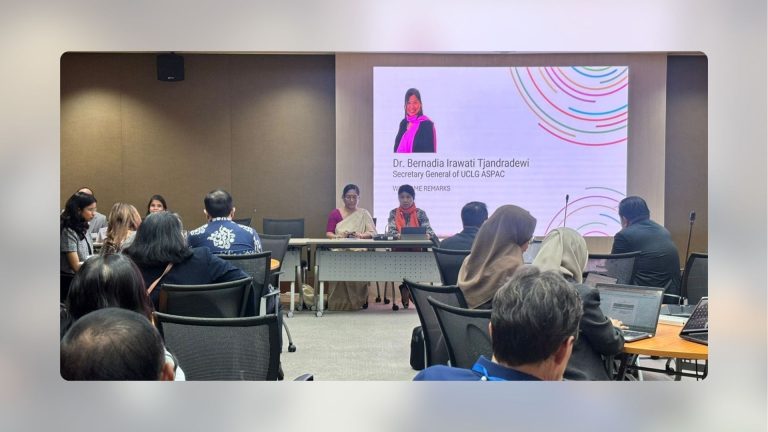




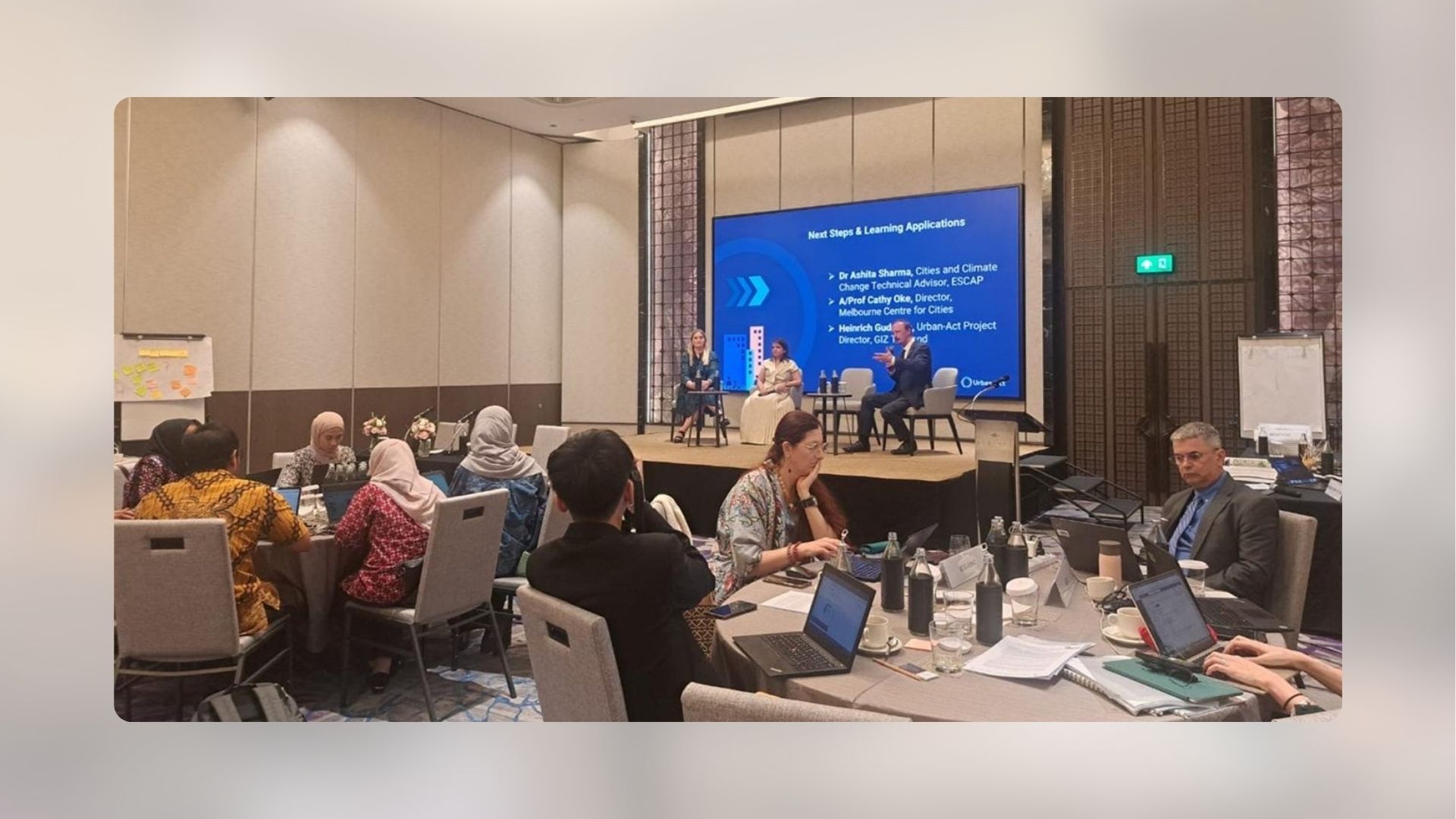
February 23-24, 2026 | Bangkok – UCLG ASPAC collaborated with the United Nations Economic and Social Commission for Asia and the Pacific (ESCAP) and the Melbourne Centre for Cities (MC4C) to co-deliver the Regional Synthesis Workshop, conducted under the framework of the Urban-Act Project. The workshop placed strong emphasis on taking a deeper dive into climate finance. While previous engagements covered a range of urban climate themes, this final module focused on strengthening project preparation, improving financial viability, and enhancing cities’ capacity to access and manage climate funding.
The event engaged representatives from Indonesia, the Philippines, Thailand, and India. From Indonesia, participants joined from Padang and Medan, alongside the Ministry of National Development Planning (Badan Perencanaan dan Pembangunan Nasional/Bappenas). The Philippines was represented by Tagbilaran, Bacolod, and Antipolo. From Thailand, delegates participated from Chiang Mai, Phuket, Khon Kaen, Hat Yai, and Nakhon Si Thammarat. India was represented by Shimla, Coimbatore, and Panaji.
Across the two days, discussions bridged technical knowledge with practical application. Participants reflected on how climate information, spatial planning, and Gender, Equality, Disability, and Social Inclusion (GEDSI) considerations can strengthen the credibility and inclusiveness of urban climate projects. The integration of disaggregated data and inclusive approaches was framed as essential for developing finance-ready proposals that address differentiated vulnerabilities and ensure equitable benefits.
A significant portion of the workshop was dedicated to urban climate finance. Participants examined key principles influencing the bankability of subnational climate projects, explored barriers to accessing finance, and engaged in hands-on application of the Urban-Act Project Finance Diagnostic Tool. This exercise enabled participants to critically assess the technical robustness, institutional readiness, and financial structuring of their proposed investments, while identifying concrete steps to strengthen their bankability and alignment with potential funding sources.
In addition, participants were introduced to the Climate Budget Tool for Cities, presented by GIZ India, which supports municipalities in tagging and tracking climate-relevant expenditures within their annual budgets. The tool encourages cities to align capital works and sectoral allocations with mitigation and adaptation priorities, thereby strengthening transparency, accountability, and strategic prioritisation. By linking budget lines to climate action tracks, the tool supports cities in mainstreaming climate objectives into regular fiscal planning processes.
Peer-to-peer exchanges further enriched the dialogue, with cities comparing national frameworks, climate budget mechanisms, and institutional structures that support subnational climate investments. The exchange was led by Ms. Debolina Kundu, Director of the National Institute of Urban Affairs (NIUA), who guided reflections on national implementation experiences and emerging institutional practices. The regional networking aspect was evident in the candid sharing of lessons learned, challenges, and emerging solutions.
The workshop coincided with the 13th session of the Asia-Pacific Forum on Sustainable Development (APFSD), the region’s annual platform for reviewing progress on the 2030 Agenda and the Sustainable Development Goals. With SDG 11 on Sustainable Cities and Communities under review, the engagement of Urban-Act cities reinforced the critical role of local governments in advancing sustainable urban development and climate resilience within the broader regional agenda.
Looking ahead, the closing sessions focused on sustaining momentum beyond the programme, including pathways toward the World Urban Forum (WUF13) and the United Nations Climate Change Conference (COP31). Participants underscored the importance of translating knowledge into implementable, finance-ready climate projects while maintaining the regional network established through Urban-Act.