




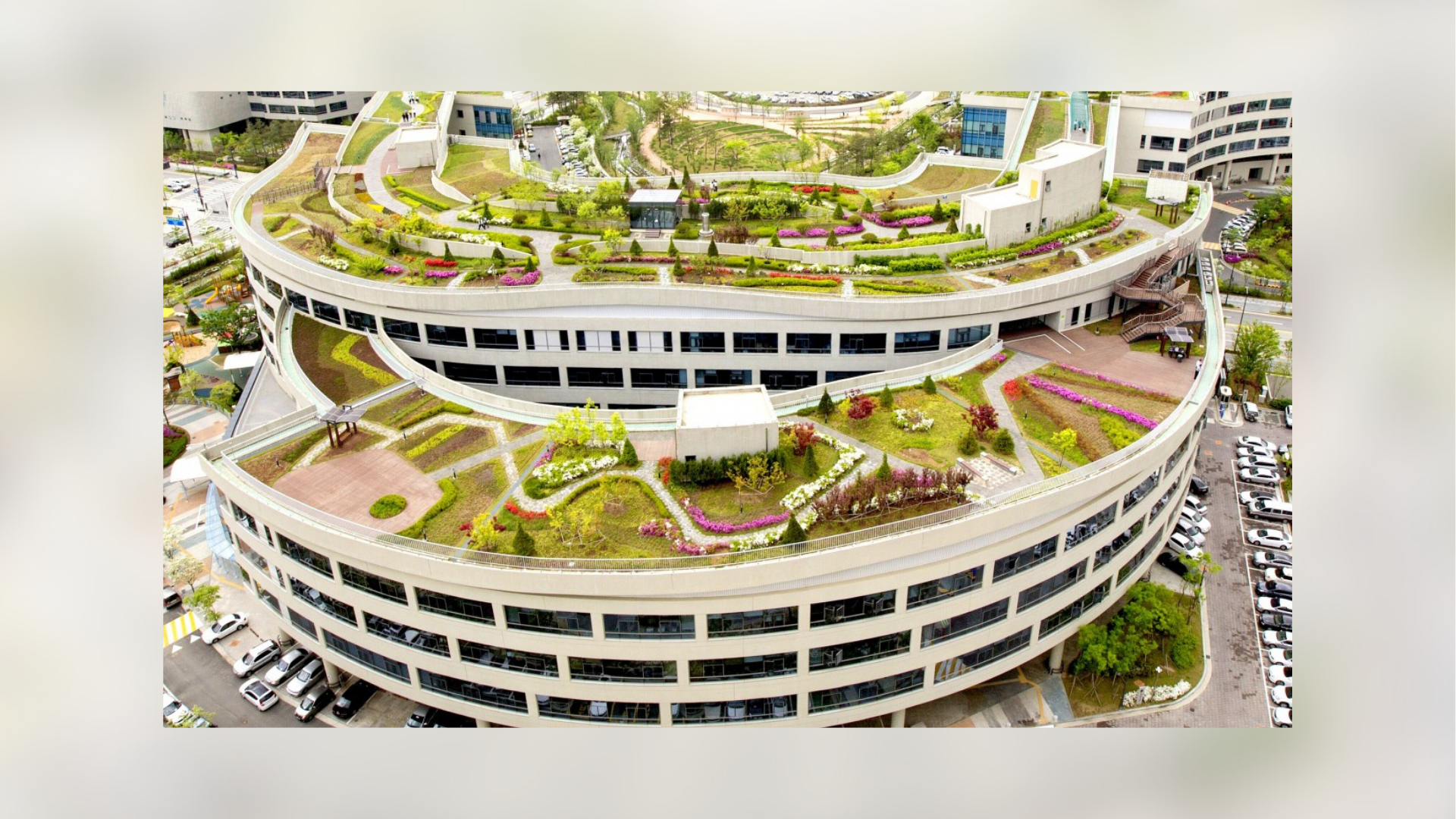
In the heart of Sejong City, South Korea’s administrative capital, an extraordinary vision of urban design has taken root—literally. The Government Complex Sejong is home to the world’s largest rooftop garden, a testament to the city’s commitment to blending nature and urban life. This remarkable green space, a Guinness World Record holder for its magnitude, is not just a garden; it’s a symbolic ribbon connecting the city’s past, present, and future.
With a total length of approximately 3.6 kilometres and spanning an area of 79,194 m2—the equivalent of 11 soccer fields—this colossal garden serves as the cornerstone of Sejong’s “Flat City, Link City, Zero City” urban design strategy. Its horizontal structure creates an uninterrupted, open view for both those strolling along the rooftop and those on the ground below. Resembling a giant green serpent on human architecture, the rooftop garden links 15 government buildings, providing a seamless pathway between government ministries.
The inspiration for this architectural marvel is steeped in Korean tradition, Sunseong-nori, a traditional practice of the Joseon dynasty. After Sunbies (young male scholars, who weren’t yet government officials) finished their civil service exams, they wandered the city walls of Hanyang (Old Seoul), hoping for good results. As Sejong succeeds in the role of an administrative capital, this ancient tradition has been recreated as a rooftop garden, blending historical reverence with innovative design.
The garden is home to 310 different plant species and 1.44 million plants in all. Visitors can enjoy a diverse array of annuals, perennials, herbs and vines throughout the year. It’s freely accessible to both citizens and government officials, but it requires a time slot reservation due to limited spaces.
Nature is not the only thing to enjoy in this garden. The rooftop features a variety of human designs that seamlessly blend into the natural environment. The Guinness Marker celebrating the record-breaking achievement, an observatory overlooking the Sejong Lake Park and the Presidential Archives, and a giant Korean flag made of Mugunghwa (Hibiscus, Korea’s National Flower) are them.
Beyond its beauty and functionality, the rooftop garden is a champion of sustainable urban living. The design team filled the rooftop with a layer of soil of approximately one meter, which acts as a natural insulator. This approach significantly minimises heat loss in winter and reduces the need for air conditioning in summer, resulting in impressive annual savings of approximately 1.4 billion Korean won in energy costs.
By connecting people, government, and nature, the Sejong rooftop garden is more than an architectural wonder—it’s a living blueprint for an inclusive, sustainable, and harmonious future. Enjoy a very special promenade in Sejong City!
Main Features
- The world’s largest rooftop garden (listed in the Guinness World Records on 29 January 2016).
- Design inspired by the Korean traditional culture called Sunseong-nori.
- Organised gardens by seasons and themes.
- 1 herb garden, 2 medicinal gardens, 2 fruit trees and berry bush gardens and 10 vine tunnels.
- 310 different plant species and 1.44 million plants