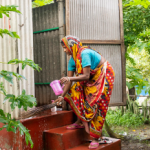
The economic condition in Nilgiris (India) depends on success and failure of horticulture crops. Climate change has resulted in limited water availability for 4-6 months. Excessive application of chemical fertilisers has resulted in declining soil fertility. Additionally, faecal sludge & solid waste in the area are poorly managed impacting the environment.
To change this negative cycle, women farmers in the Nilgiris buy and apply co-compost. This co-compost is produced by women self-help groups through mixing domestic organic waste with faecal sludge. The sites are owned by local governments. Women farmers are organised into Women Farmers Groups or Producer Groups. They access the market directly by obtaining advance purchase orders by an agri-marketing company named LEAF to procure crops grown by farmers (to eliminate middle-men).
Women farmers who use co-compost were surveyed. Familiarity and high demand for regular compost makes the adoption process of co-compost much easier. Promotion of co-compost is marketed directly through FPGs & FGs. Regular feedback sessions with farmers on co-compost helps to understand their needs and gets “social certification” from them.
- Establishment of faecal sludge treatment sites in cooperation with women SHGs and local governments.
- Organisation of private faecal sludge collectors.
- Capacity building (technical and business) of women SHGs to operate co-compost production sites.
- Production, sales and marketing of co-compost with ongoing monitoring and evaluation.
Bangladesh has set up solid foundation towards achievement of SDG 6.2 through the achievements on FSM. It is now time for the Country to go above and beyond. Mainstreaming the concepts of IRF and CWIS in the national policy can serve as Bangladesh’s important step stone towards achieving the SDGs and urban agenda.